

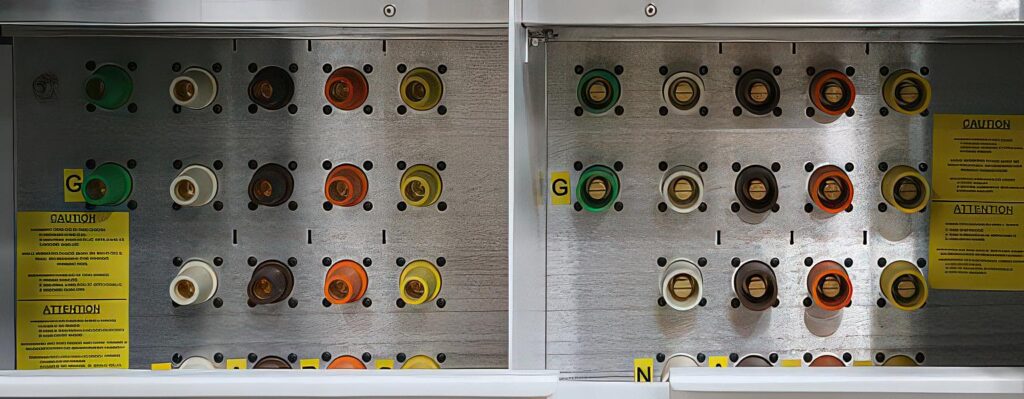
If your new building or major alteration project is planning for a permanent emergency generator, there’s an NEC (National Electrical Code) requirement that’s easy to miss in early design but likely expensive to fix later: NEC 700.3(F). Article 700.3(F) requires some emergency loads to switch over to a temporary source of back-up power whenever the permanent back-up source is down for maintenance or repair — and depending on your building type, that requirement can equate to a visible piece of equipment mounted on the building facade.
This article breaks down what NEC 700.3(F) requires and specifically how it is applied to R-1 and R-2 occupancies in New York City. The same logic path presented here could be used for other states and jurisdictions however be sure to do your research and spend sufficient time evaluating the codes specific to your project location.
What NEC 700.3(F) Requires
In cases where an emergency system depends on a single alternate source of power — most commonly, a permanent on-site emergency generator — the NEC requires a permanent switching means to connect an additional, portable or temporary, alternate power source. This backup connection must be available while the permanent emergency generator is out of service.
The switching means itself must meet several conditions:
- Connecting the portable/temporary source can’t require modifying the permanent system’s wiring.
- Power transfer between normal and emergency sources must follow NEC 700.12.
- The connection point must be marked with phase rotation and bonding information.
- Mechanical or electrical interlocking must prevent the two sources from being connected at the same time.
- The switching means must include a contact that signals — at the generator or a monitoring system — when the permanent source is disconnected.
Does This Apply to All Buildings?
Not necessarily, it depends on specific occupancy requirements.
Group R-2 (Multi-Family Residential), High Rise over 125 ft
NEC 700.3(F) only applies if the permanent generator is the sole alternate source for an Article 700 emergency load. If each emergency load already has its own independent backup — a battery pack or inverter, for example — the generator isn’t functioning as a “single alternate source” for those loads, and the requirement may not apply at all.
For a typical R-2 building over 125 ft, here’s how that usually shakes out:
| Emergency Load | Independent Alternate Source | Triggers 700.3(F)? |
| Emergency lighting / exit signs | Inverter or battery pack | No |
| Fire alarm system | Battery backup | No |
| ARCS | Battery backup | No |
| Gas booster | Battery backup (UPS) | No |
| Fire pump | Not required if power is tapped ahead of main | No |
Bottom line for R-2 High Rise over 125 ft: when every emergency load has its own independent backup, the portable generator docking station is often avoidable. But this determination should be confirmed on a project-by-project basis, and it needs to happen early — the docking station has direct facade implications and needs to be coordinated with the architect and developer from the outset, not deferred to the CD phase.
Group R-1 (Hotels/Transient Residential)
Here the answer is different. An R-1 building’s fire pump is required to be powered by the emergency generator, and the fire pump is an Article 700 emergency load. If it relies solely on the permanent generator as its alternate source, NEC 700.3(F) applies, and a docking station or indoor cable pathway becomes necessary. There is no allowance for R-1 occupancies to connect the fire pump ahead of the main service OCPS’s to avoid backup power.
Two things worth flagging early on R-1 projects:
- The facade implications are significant for residential hotel projects and need architect coordination from project inception.
- A larger than anticipated roll-up portable generator may be needed to handle a fire pump load due to high start-up current— this needs to be evaluated by the electrical engineer and communicated to the building owner early, not discovered during a maintenance event.
Other Occupancies
There are other occupancies or special uses that may have conditions that trigger 700.3(F). Project teams should review Chapter 27 of the New York City Building Code for further information.
Where Does the Connection Point Go?
The 2020 NEC code doesn’t say it has to be outdoors, however the 2023 NEC amends 700.3(F) and limits the installation of the connection point to be outdoors.
To date in the NYC area two approaches have commonly been used:
Exterior Docking Station (recommended)
A cam-lok or similar cabinet mounted on an exterior wall. The portable generator parks outside with a short cable run to the docking station. This is the typical approach for high-rise residential — but it does affect the building’s facade.
Indoor Connection with dedicated Cable Pathway (proceed with caution – see update below)
The docking station is located within an electrical room, with a dedicated conduit path, hatch or vault allowing temporary conductors to be routed in from outside. The generator itself stays outside; this method allows for a more discreet installation.
Update: EP has reached out to the NYC Department of Buildings for formal clarification on whether an indoor connection point satisfies the intent of NEC 700.3(F), since neither the current NEC nor the NYC building code explicitly addresses interior vs. exterior placement. Given that the latest NEC cycle limits installations to outdoors, it is plausible that NYC could issue an amendment to match the 2023 NEC prescription. We’ll update this article once a response is received.
Design Checklist
- Confirm whether the project has a permanent emergency generator serving Article 700 emergency loads.
- Review local building and electrical code for specific occupancy/building specification requirement, and any electrical code amendments to 700.3(F) that would affect your project.
- Identify all emergency loads and confirm whether each has an independent alternate source (battery/inverter).
- For R-2: if all loads have independent backups, get written confirmation from your electrical engineer that 700.3(F) doesn’t apply.
- For R-1, or any project with a generator-fed fire pump: coordinate the docking station or indoor cable pathway with the architect early — this is a facade decision, not a punch-list item.
- Confirm the exterior connection point location is shown on architectural drawings and flag the aesthetic impact for residential facades.
How Can EP Help?
EP Engineering works through this exact determination on all types of projects regularly — including confirming whether 700.3(F) applies, sizing the required portable generator capacity, and coordinating docking station or indoor connection design with the architectural team. Reach out to info@epengineering.com to be connected with someone who can assist.
Note to reader: This article provides a general overview of NYCEC 700.3(F) and its practical implications for R-1 and R-2 occupancies. Applicability depends on project-specific emergency load configurations and should be confirmed by a licensed electrical engineer on a case-by-case basis. The full requirement can be reviewed in NFPA 70, the National Electrical Code, available through NFPA’s free access portal at nfpa.org/70. Relevant NYC Building Code emergency and standby power provisions (BC 403.4.8.3.2, BC 403.4.8.4.2, and BC 3007.8) can be reviewed at nyc.gov/buildings or via a third-party code reference such as up.codes — note that up.codes is not an official code source and should be cross-checked against the current adopted NYC Building Code text. The FSAE emergency/standby classification and indoor connection point questions noted above are pending formal clarification from the NYC Department of Buildings; this article will be updated once a response is received.